ModelPort




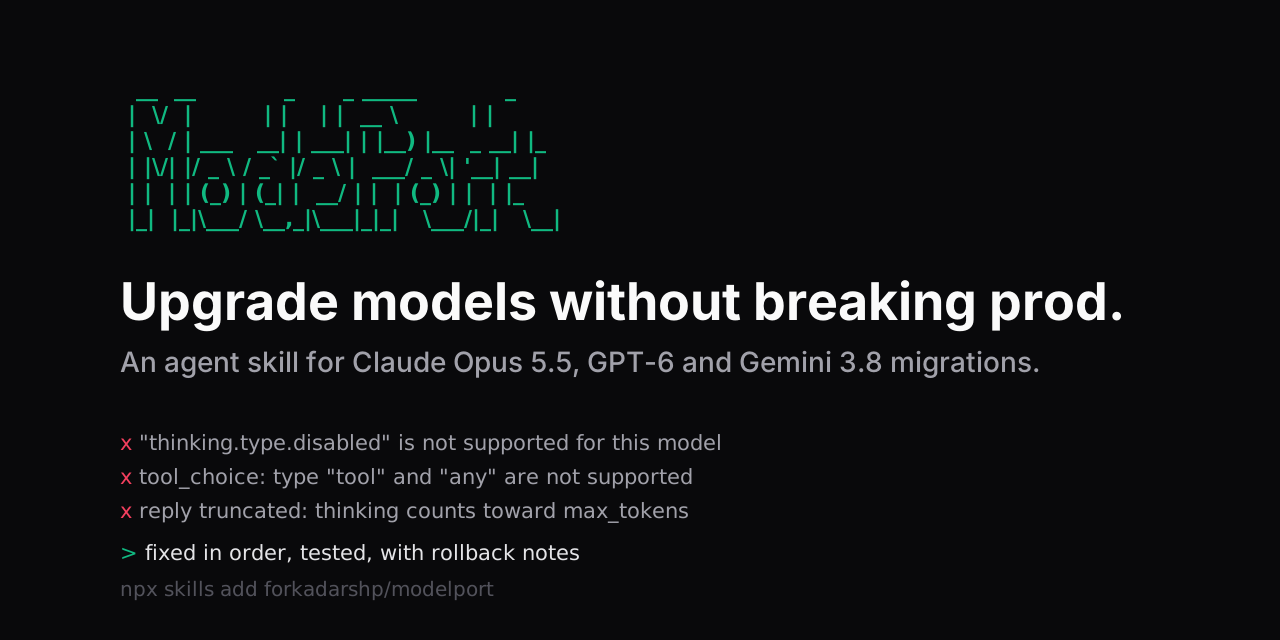
Upgrade to Claude Opus 5.5, GPT-6, or Gemini 3.8 without breaking prod.
ModelPort is an agent skill for Claude Code, Codex, and Cursor. It migrates the prompts, tool definitions, API calls, and tests around a model swap, using per-model guides that track each provider’s breaking changes. Then it proves the upgrade worked with tests, a live smoke check, and optional old-vs-new evals.
Install:
npx skills add forkadarshp/modelport, then tell your agent “migrate this repo to claude-opus-5-5”. See Quickstart.
Seen one of these after a model swap?
"thinking.type.disabled" is not supported for this model.
tool_choice: type "tool" and "any" are not supported for this model.
'claude-opus-5-5' does not support tool types: computer_20251124.
temperature / top_p / logprobs rejected after moving to GPT-6
thinking_budget and thinking_level in the same request (Gemini 3.x) → 400
stop_reason: "refusal" and code that reads content[0]
Changing the model ID is one line. The 400s, the truncated replies (thinking now
counts toward max_tokens), the quiet UI between tool calls, and the parsers
that stop matching are everything else. The lookup for all of them is in
references/breaking-changes.md. ModelPort
applies the fixes for you, in order, and shows its evidence.
What you get
- Current-model knowledge. Dedicated guides for Claude Fable 5.1, Opus 5.5, Sonnet 5.5, Haiku 5.5, GPT-6, and Gemini 3.8 Flash. Older guides layer underneath for upgrades that start further back.
- Guides that stay fresh. Every guide has a
Last verified:date and aSource:. A weekly job flags stale guides, and the skill re-checks the provider’s docs before trusting an old one. - A migration, not a find/replace. Scope lock, caller discovery, file classification, required fixes kept apart from optional tuning, then validation and rollback notes.
- Proof. Tests, a live smoke call, and an optional three-arm benchmark (old model, naive swap, ModelPort) with a runnable harness.
Supported models
| Provider | Models with a dedicated guide |
|---|---|
| Anthropic | Claude Fable 5.1, Opus 5.5, Sonnet 5.5, Haiku 5.5 (legacy: Opus 4.8, Opus 4.6, Sonnet 4.5) |
| OpenAI | GPT-6 Astra, GPT-6.1 Sol, GPT-6 Sol, GPT-6 Luna (legacy: GPT-5.5) |
| Gemini 3.8 Flash | |
| Anything else | Generic playbook plus provider checklists, with research on the target’s docs |
Registry, upgrade paths, and freshness rules: references/models/INDEX.md.
Example
Use $modelport-skill to migrate this codebase to claude-opus-5-5.
Apply required compatibility fixes first, keep tool + output behavior stable,
and return validation evidence plus rollback notes.
You get back a report with: what changed and why, required fixes versus optional tuning, test and smoke results, risks, and how to roll back. A sample is in examples/example-output.md.
How it works
A strict, phase-gated pipeline. The skill will not edit before scope is locked and will not claim “done” without proof.
╭──────────────────────────────────────────────────────────────────────╮
│                                                                      │
│   [ old model ]  ═══>  ( ModelPort )  ═══>  [ new model ]            │
│   what you run        behavior-preserving   what you ship            │
│                                                                      │
│   » phase 0   lock scope, read current state ················· [ OK ]│
│   » phase 1   discover callers, prompts, agents, tools ······· [ OK ]│
│   » phase 2   classify every hit before editing ·············· [ OK ]│
│   » phase 3   design: required fixes vs optional tuning ······ [ OK ]│
│   » phase 4   surgical patches, no blind search/replace ······ [ OK ]│
│   » phase 5   validate: tests + live smoke + contract ········ [ OK ]│
│   » phase 6   report: proof evidence + rollback notes ········ [ OK ]│
│                                                                      │
╰──────────────────────────────────────────────────────────────────────╯
Beyond the model ID
ModelPort also adjusts prompts, tool descriptions, and guardrails to match how
the target model behaves, including changes the changelog barely mentions. Two
examples from the current generation: Claude Opus 5.5 defaults to medium
effort, one level below Opus 5, so an untouched config quietly thinks less. And
Claude Sonnet 5.5 can read a user message that arrives right after a tool result
as a prompt injection, so mid-task user input must be delivered as a user turn.
Each guide lists these as required fixes or optional tuning, never mixed.
Benchmark the upgrade
Opt in and ModelPort ends with measured evidence. It runs the same eval set against three configurations so the raw model delta and the skill’s value are attributed separately:
- Baseline: old model, old prompts (where you started)
- Naive swap: new model, old prompts (what a find/replace gets you)
- ModelPort-enhanced: new model, enhanced system (where you land)
Sample leaderboard from the bundled offline simulator. The simulator models only prompt explicitness and a per-model “literalness” knob, so these numbers show the report format, not real model performance:
╭──────────────────────┬────────────┬────────────┬────────────╮
│ metric               │ baseline   │ naive swap │ ModelPort  │
│                      │ (old/old)  │ (new/old)  │ (new/enh.) │
├──────────────────────┼────────────┼────────────┼────────────┤
│  task success        │        64% │        57% │        93% │
│  output contract     │        64% │        57% │        93% │
│  tool-call accuracy  │        64% │        57% │        93% │
│  p95 latency         │       4.1s │       2.5s │       2.5s │
│  cost / req          │    $0.0008 │    $0.0006 │    $0.0009 │
├──────────────────────┼────────────┼────────────┼────────────┤
│  composite (50/30/20)│       0.57 │       0.63 │       0.76 │
╰──────────────────────┴────────────┴────────────┴────────────╯
Get real numbers: python3 harness/run.py --provider anthropic (needs
ANTHROPIC_API_KEY). The harness works with current Claude models: it never
sends parameters they reject and leaves room for always-on thinking. Details in
harness/README.md and
references/benchmarking.md.
Quickstart
1. Install. Pick the line for your agent.
# Any agent (Claude Code, Codex, Cursor, and others)
npx skills add forkadarshp/modelport
# Claude Code, as a plugin
/plugin install modelport --marketplace forkadarshp/modelport
2. Ask. In your project, tell the agent where you are going:
Migrate this repo to claude-opus-5-5. Keep tool and output behavior the same.
3. Read the report. You get the changes, the test and smoke results, the risks, and the rollback steps. Nothing is called done without evidence.
Copy-paste prompts
| Goal | Prompt |
|---|---|
| Latest Claude | Migrate this repo to claude-opus-5-5. Apply required fixes first, then list optional tuning separately. |
| Cheaper and faster Claude | Move the classification and routing calls in src/ to claude-haiku-5-5 and keep the output format identical. |
| GPT-6 | Migrate our OpenAI calls from gpt-5.5 to gpt-6.1-sol. Move tool calling to the Responses API where needed. |
| Gemini | Upgrade our Gemini calls to gemini-3.8-flash and replace thinking_budget with thinking_level. |
| Switch provider | Port services/assistant from OpenAI to Claude Sonnet 5.5. Keep the JSON output contract and tool behavior. |
| Fix a broken swap | We changed the model ID and now get 400s. Find the cause and fix it. |
| Prove it | Migrate to claude-opus-5-5 and benchmark old vs new on our eval set. |
More in examples/example-prompts.md.
Why not just read the migration guide?
The provider’s guide tells you what changed. You still have to find every caller, decide the fix order, re-tune prompts, and check nothing regressed.
| Provider migration guide | Asking your agent with no skill | ModelPort | |
|---|---|---|---|
| Knows the current breaking changes | Yes, one provider | Only if it is in its training data | Yes, across providers, dated and sourced |
| Finds every caller, prompt, and tool definition | You do it | Sometimes | Discovery phase, then classification |
| Keeps required fixes apart from tuning | No | Rarely | Always, and labeled |
| Ends with evidence | No | Rarely | Tests, live smoke check, rollback notes |
| Compares old vs new | No | No | Optional three-arm benchmark |
Manual Installation (Advanced)
If you prefer to fork and modify the skill locally:
Clone:
git clone https://github.com/forkadarshp/modelport.git
cd modelport
Install as a local skill with a symlink (Codex example):
mkdir -p ~/.codex/skills
ln -s "$(pwd)" ~/.codex/skills/modelport-skill
Or copy directly:
mkdir -p ~/.codex/skills/modelport-skill
cp -R . ~/.codex/skills/modelport-skill
Then ask your agent:
Use $modelport-skill and the starter prompt template to migrate
services/assistant from Model A to Model B. Keep tool behavior stable, separate
required fixes from optional tuning, and include validation evidence plus
rollback notes.
For detailed migration requests, start from templates/migration-starter-prompt.md.
What it migrates
| Area | Migration support |
|---|---|
| API callers | Model IDs, request parameters, response contracts, SDK usage |
| Prompts | System prompts, templates, output contracts, brittle prompt hacks |
| Agents | Tool policy, orchestration behavior, autonomy, handoff instructions |
| Tools | Schemas, descriptions, validation rules, guardrails |
| Config | Model registries, routers, feature flags, rollout controls |
| Tests and docs | Fixtures, assertions, examples, migration notes |
| Benchmarks | Optional pre/post stats: quality, latency, cost, contract drift |
Built for real migrations
- Scope lock before edits to avoid accidental repo-wide churn.
- Discovery pass across API calls, prompts, agents, tools, tests, and docs.
- File classification before modification.
- Migration-pattern selection across direct swap, adapters, shadow mode, canary, and expand-contract changes.
- Required fixes and optional tuning reported separately.
- Explicit coordination checks for work another agent has already started.
- Validation-first completion criteria with tests, smoke checks, and rollback notes.
Example migration prompts
- “Migrate all model usage in
src/agents/from our old model config to the new release, keep tool behavior stable, and give me a rollback plan.” - “Upgrade this codebase from provider A to provider B and adjust prompts so output format remains identical.”
- “Replace deprecated model parameters in our API callers and verify tests still pass.”
- “Do a phased migration in
services/searchwith side-by-side support for old and new models.”
More examples are in examples/example-prompts.md.
Expected output
The skill guides your agent to produce a migration report with:
- Migration summary
- Scope and files changed
- Existing work and remaining work
- Required compatibility fixes
- Prompt and agent behavior tuning
- Validation results
- Proof evidence
- Risks and follow-up recommendations
- Rollback notes
- Benchmark results (when benchmarking was requested)
See examples/example-output.md for a sample report.
Repository structure
.
├── .claude-plugin/            (Claude Code plugin + marketplace manifests)
├── .markdownlint-cli2.yaml
├── _config.yml               (GitHub Pages site config)
├── SKILL.md
├── README.md
├── CONTRIBUTING.md
├── CODE_OF_CONDUCT.md
├── SECURITY.md
├── LICENSE
├── assets/
│   └── social-preview.svg
├── scripts/
│   ├── validate_skill.py
│   └── check_freshness.py
├── harness/                  (offline + live old-vs-new benchmark)
├── templates/
│   └── migration-starter-prompt.md
├── references/
│   ├── benchmarking.md
│   ├── breaking-changes.md
│   ├── migration-patterns.md
│   ├── migration-playbook.md
│   ├── output-style.md
│   ├── prompt-template-research.md
│   ├── provider-checklists.md
│   ├── validation-proof.md
│   └── models/
│       ├── INDEX.md
│       ├── claude-fable-5-1.md
│       ├── claude-opus-5-5.md
│       ├── claude-sonnet-5-5.md
│       ├── claude-haiku-5-5.md
│       ├── gpt-6.md
│       ├── gemini-3-8-flash.md
│       ├── claude-opus-4-8.md      (legacy)
│       ├── claude-opus-4-6.md      (legacy)
│       ├── claude-sonnet-4-5.md    (legacy)
│       └── gpt-5-5.md              (legacy)
├── examples/
│   ├── example-prompts.md
│   └── example-output.md
├── agents/
│   └── openai.yaml
├── docs/
│   └── PUBLISHING.md
└── .github/
    ├── ISSUE_TEMPLATE/
    ├── pull_request_template.md
    └── workflows/
        ├── ci.yml
        └── freshness.yml
Validate locally
python3 scripts/validate_skill.py .
npx markdownlint-cli2 "**/*.md"
Open-source readiness
- MIT license included.
- CI validates Markdown and skill structure.
- Issue templates cover bugs, features, and migration case studies.
- PR template asks contributors to classify migration relevance.
- Security reporting process included via GitHub Security Advisories.
- Skill UI metadata included in
agents/openai.yaml.
Roadmap
- Per-model migration guides for Claude Fable 5.1 / Opus 5.5 / Sonnet 5.5 /
Haiku 5.5, GPT-6, and Gemini 3.8 Flash ship today in
references/models/, with legacy Claude and GPT-5.5 guides layered underneath. Next: Gemini Pro and Flash-Lite guides, and self-hosted models. - Add regression fixtures for prompt, tool, and structured-output migrations.
- Add OpenAI and Gemini providers to the benchmark harness (Anthropic and an offline simulator ship today).
- Add real-world before/after migration case studies.
FAQ
How do I fix “thinking.type.disabled is not supported for this model”?
Claude Opus 5.5 and Fable 5.1 always think, so thinking: {type: "disabled"}
returns a 400. Remove the thinking field and set output_config.effort to
low if you need speed. On Sonnet 5.5, use {type: "between_tools"} when a
route must stay thinking-off. Details in the
Opus 5.5 guide.
How do I fix “tool_choice: type tool and any are not supported for this model”?
Forced tool use is gone on Claude Opus 5.5, Sonnet 5.5, and Fable 5.1. Use
tool_choice: {type: "auto"} with strict: true on the tool and a prompt
instruction, then check that a call happened. If the forced call only existed
to get JSON back, use structured outputs.
Why are my replies cut off after upgrading Claude?
Thinking is on by default on the newer models and counts toward max_tokens. A
limit sized for a short answer can be used up before any text is written. Raise
max_tokens or lower effort, and read content blocks by type because the
first block may be a thinking block.
What changes when I move from GPT-5.5 to GPT-6?
Tool calling moves to the Responses API on Astra and 6.1 Sol, temperature,
top_p, and logprobs go away when reasoning is on, and the none and
minimal effort levels are not supported on those two models. See the
GPT-6 guide.
What changes when I move to Gemini 3.8 Flash?
Replace thinking_budget with thinking_level (sending both returns 400),
drop the minimal level, and remove sampling parameters and prefilled model
turns. See the Gemini 3.8 Flash guide.
How do I migrate to Claude Opus 5.5?
Install ModelPort, then ask your agent: “migrate this repo to
claude-opus-5-5.” It reads the
Opus 5.5 guide, applies the required
compatibility fixes, preserves tool calling and output contracts, and returns
validation evidence plus rollback notes.
How do I migrate from an older Opus (4.x) to the latest?
Upgrades layer. From 4.7 or older, ModelPort applies the
Opus 4.8 guide first (sampling params,
adaptive thinking, tokenizer, removed prefills), then the Opus 5.5 changes
(thinking always on, forced tool_choice removed, preserved thinking, computer
toolset), and re-baselines effort, whose default is now medium.
Will changing the model ID break my tool calling or output format?
Often, yes — and that’s the problem ModelPort exists to solve. Newer models follow instructions more literally and re-tokenize differently, so a raw find/replace can silently break tool calls and parsers. ModelPort goes beyond the model ID: it updates prompts, tool descriptions, and guardrails to match the target model’s actual behavior — researched from observed runs, web research, and provider changelogs, including unadvertised quirks — then validates the contract before finishing.
How do I benchmark a new model against my current one?
Opt into benchmarking at the start and ModelPort runs a three-arm comparison — baseline, naive swap, and the enhanced system — on the same eval set, then reports a leaderboard with quality, latency, cost, and contract metrics. See references/benchmarking.md.
Does it work with Claude Code, Codex, and Cursor?
Yes. Install it with npx skills add forkadarshp/modelport for any compatible
agent, or as a Claude Code plugin with
/plugin install modelport --marketplace forkadarshp/modelport.
Do I need an API key or an account?
No. The skill is a set of instructions and guides your agent reads. An API key is needed only if you run the benchmark harness against a live model.
Which models and providers does it support?
Any model or provider swap (Anthropic, OpenAI, Google, and others). It ships dedicated migration guides for Claude Fable 5.1, Opus 5.5, Sonnet 5.5, and Haiku 5.5, GPT-6, and Gemini 3.8 Flash (plus legacy Claude and GPT-5.5 guides), and a generic playbook for everything else.
Contributing
See CONTRIBUTING.md.
Security
See SECURITY.md.
License
MIT - see LICENSE.